Something About Cabo Slows Your Clock Down — And Science Has a Pretty Good Explanation
You know that feeling on day two of a Cabo trip when you genuinely can't remember what day of the week it is — and somehow that's completely fine? When the idea of checking your work Slack feels as absurd as wearing a tie to the beach? That's not laziness. That's not even really relaxation in the way most people think about it. Something more interesting is happening inside your head, and it starts the moment the desert heat wraps around you like a slow exhale.
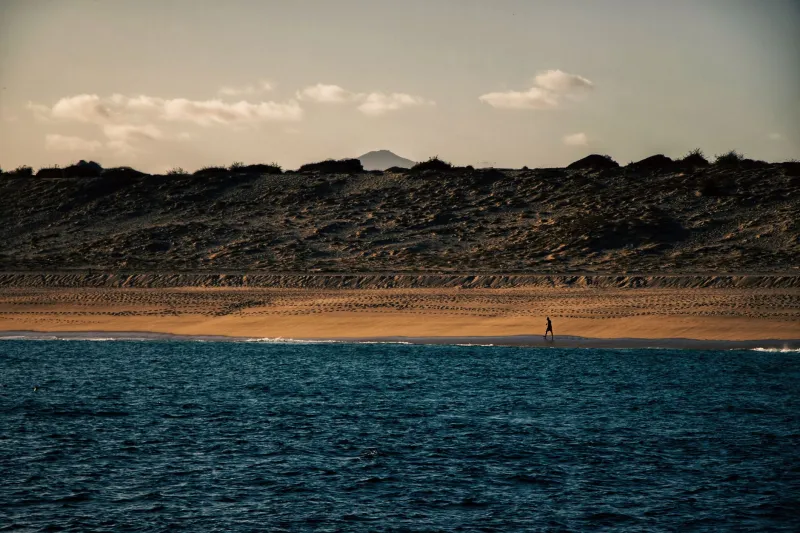
Cabo San Lucas sits at the tip of the Baja Peninsula, where the Pacific and the Sea of Cortez collide in a way that feels almost theatrical. The landscape is dramatic — raw saguaro and cardón cactus rising out of bone-dry earth, then suddenly giving way to turquoise water so clear it looks rendered. That contrast isn't just pretty. For your nervous system, it's genuinely disorienting in the best possible way.
Your Brain on Desert Air
Here's the thing about cortisol — the stress hormone your body produces in response to deadlines, notifications, traffic, and the general relentlessness of modern American life: it doesn't just disappear because you booked a flight. It needs something to actually displace it.
Environmental psychology researchers have spent decades studying how natural settings affect stress response, and the data keeps pointing in the same direction. Exposure to high-contrast natural environments — particularly combinations of arid heat and open water — triggers measurable drops in cortisol within 20 to 30 minutes. The ocean itself plays a role. The sound frequency of breaking waves has been shown to shift brainwave activity toward patterns associated with calm focus, the kind your brain produces just before sleep or during meditation.
Cabo's particular geography stacks these effects. The desert heat slows you down physically — you simply can't move at the same pace you would in an air-conditioned office. The salt air carries negative ions, which have been linked to elevated serotonin levels. And the light is different here. That warm, golden intensity that makes every sunset look like a painting? It's also recalibrating your circadian rhythm, pushing your body toward a more natural sleep-wake cycle that most Americans have quietly abandoned.
Why the Big Decisions Happen Here
Ask around — really ask — and you'll find a remarkable number of people who made significant life decisions in Cabo. The couple who decided to stop putting off having kids. The marketing director who drafted her resignation letter on a napkin at a beachside palapa. The guy from Phoenix who called his business partner from a fishing boat and said, simply, "I think we should do it."
This isn't coincidence, and it's not just the margaritas.
When cortisol drops and serotonin rises, the prefrontal cortex — the part of your brain responsible for planning, values-based reasoning, and long-term thinking — becomes more active relative to the amygdala, which handles fear and threat response. In plain terms: you get better at thinking about what you actually want instead of what you're afraid of losing. The risk calculus shifts. Things that felt impossibly scary from inside your routine start to look, if not easy, at least possible.
There's also something about physical distance from your environment that creates psychological distance from your identity. Anthropologists call it liminality — the threshold state where you're temporarily outside your usual role and social structure. Cabo, for a lot of Americans, functions as a liminal space. You're not quite yourself. You're not quite not yourself. You're something more honest than either.
The Rhythm That Gets Under Your Skin
Part of what makes Cabo so effective at this kind of reset is that the place has its own pace, and it's unapologetically slow. Locals here have a relationship with time that visitors initially find baffling and eventually find liberating. Lunch can last three hours. Nobody is rushing toward anything. The fishing boats go out when the light is right, not when the schedule says so.
For Americans — who are, by most global measures, among the most chronically time-pressured people on earth — this is profoundly countercultural. The US runs on urgency. Cabo runs on tides.
Sitting at a table in the Medano Beach area as the afternoon light goes amber, watching pelicans work the shoreline while someone somewhere is playing guitar badly and happily, you start to absorb a different relationship with the present moment. Not because you've had some revelation. Just because the environment keeps pulling your attention back to right now. The heat. The sound. The smell of the ocean and somebody's grilled fish two tables over.
This is mindfulness without the app. And it turns out to be surprisingly sticky.
What You Bring Back
The research on what psychologists call "awe experiences" — moments when you encounter something that exceeds your normal frame of reference — shows that they reliably produce a shift in time perception. People who've just experienced awe consistently report feeling like they have more time, feel less rushed, and make more patient, values-aligned decisions in the hours and days that follow.
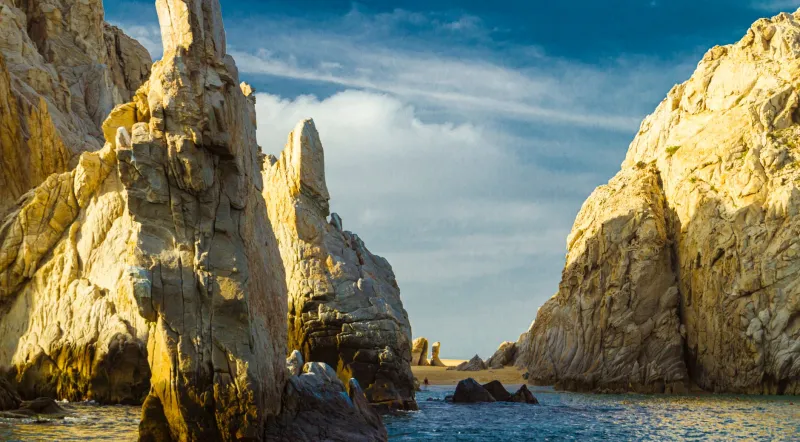
Cabo is, at its core, an awe machine. The arch at Land's End. The bioluminescence in the water at night. A whale breaching close enough that you feel the displaced air. A desert canyon that opens suddenly onto a view of the sea. These moments don't just feel good — they reorganize your priorities in ways that persist after you've cleared customs and picked up your bags at baggage claim.
People who travel to Cabo regularly will tell you it's not really about the restaurants or the resorts or even the beaches, though all of those are genuinely excellent. It's about the recalibration. The way a few days here can make the stuff that felt urgent feel optional, and the stuff that felt optional feel essential.
How to Let It Actually Work
If you're heading to Cabo and you want the full psychological benefit — not just a tan and a hangover — a few things help. Leave the first day mostly unscheduled. Let your nervous system decompress before you start optimizing your itinerary. Get outside the resort footprint early. Walk somewhere. Eat something you can't identify. Sit by the water without your phone for at least 30 minutes.
And pay attention to what comes up. The thoughts that surface in Cabo — the ones that feel too big or too inconvenient to think at home — are often the ones worth listening to. There's a reason they're showing up now, in this light, in this heat, with this much distance from everything that usually crowds them out.
Cabo doesn't fix your life. But it has a way of showing you which parts of it actually need fixing — and giving you just enough of a break from the noise to hear the answer clearly.